 Ocean Flux
Teaching · myth cards · hard stops stay true
Misconceptions about ocean iron and biology
Address myths that put ocean iron and ocean biology in a bad light — without “everything is fine” PR. Name real risks, keep hard stops true, and point at natural and anthropogenic forcing. Ecology first. Carbon secondary —
Source: Author et al. (Year) = Source tag: the primary source was checked; on claim chips the tag names the citation and itself opens the paper (doi.org). Legend chips above are keys only. Assumption = working hypothesis or teaching value, not a cited source. Rule = Ocean Flux explorer or ops interlock — an Ocean Flux rule, not a published-paper source. Chl-a Δ alone never unlocks success.
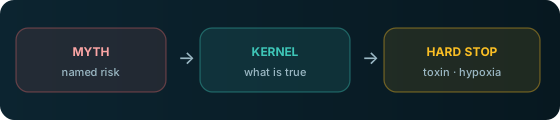
Page posture
- Real risks exist; Ocean Flux keeps hard biological stops (toxin, hypoxia, anomalous bloom without grazers). Rule · caution bands stay Assumption until Phase B regional thresholds.
- Bulk chlorophyll rise ≠ restoration success or sequestration. Source: Li et al. (2025) (ecology literacy) — Li et al. (2025) eddy asymmetry is teaching only.
- Coastal eutrophication / dead-zone story ≠ open-ocean HNLC Fe story. Source: Moore et al. (2013) (regime contrast; Moore et al. 2013).
- We do not publish “the ocean is biologically dead.” Disabled recycling and lost biogenic Fe flux are the careful framing.
Biology
HAB / toxin, hypoxia, food-web myths
-
B1 “Any iron stimulus = toxic bloom / HAB catastrophe”
Iron can favour toxigenic diatoms — that is why we stop on toxin, not why we pretend the risk is imaginary.
Explorer · toxin stop Explorer · 10×/100× assay gates Biology brief
-
B2 “Nutrient / Fe work always causes oxygen depletion / dead zones”
Hypoxia is a real stop condition — and coastal dead zones are not the same problem as iron-limited HNLC waters.
Explorer · O₂ stop Explorer · MLD > 0 Email for a copy — Forcing review
-
B3 “Nutrient depletion (or addition) kills the food web”
Food webs fail from bad community outcomes and lost recycling — not from a single chlorophyll number, and not from pretending HNLC is a dead zone.
Explorer · quality over bulk Chl Explorer · C:N allowlist band Email for a copy — Forcing review
Chemistry
Fe form, ligands, stoichiometry, recipe load
-
C1 “Any iron = toxic bloom / iron is poison”
Iron risk depends on form, ligands, and community outcome — toxin remains a hard stop.
Explorer · toxin stop Chemistry brief Email for a copy — Forcing review
-
C2 “More iron always helps (stoichiometry / ligands don’t matter)”
Bioavailable iron is gated by ligands and stoichiometry.
Explorer · C:N band Explorer · Febio / guild quality Chemistry brief
-
C3 “Organic / waste recipes are just nutrients — NH₃ and BOD don’t matter”
Ligand-rich organics can help iron stay dissolved — and the same recipes can fail on ammonia or oxygen demand, so those metrics hard-stop the explorer.
Explorer · ΔNH₃/BOD abort Explorer · recipe allowlist Explorer · assay dilution gates
Physics
Mixing, upwelling, eddies, air–sea
-
P1 “Ocean biology / iron stories ignore physics — it’s just dumping fertilizer”
Mixing and dilution are first-class controls alongside chemistry.
Explorer · dilution gates Explorer · MLD & dose rate Physics brief
-
P2 “Eddies (or ‘the pump’) fix carbon — so iron/biology risk talk is moot”
Eddies reshape CO₂ exchange by polarity and biology — they don’t cancel HAB or hypoxia stops.
Explorer · inventory framing Physics · Li 2025 teaching note Disclaimer · debate path
-
P3 “If oxygen drops, iron (or biology) must be the villain — physics doesn’t matter”
Oxygen risk is about biology and ventilation — hypoxia is a physics-aware hard stop.
Explorer · hypoxia stop Explorer · MLD Email for a copy — Forcing review
-
P4 “Nutrient depletion myths ignore that physics still supplies macros while biology recycles Fe”
Physics can still lift nitrate while regenerative iron fluxes are impaired — depletion is not one story.
Explorer · MLD / supply context Email for a copy — Forcing review Physics brief
Further reading
-
Anthropogenic iron forcing review
Fisheries / whaling Fe removal, pollution speciation, biogenic recycle — literature synthesis.
-
Discipline briefs
Biology · Chemistry · Physics · Science hub
-
Debate & transparency
Critique welcome. Models are assumptions unless labeled with a Source tag. See the Disclaimer debate path and Support (personal project).
Selected public cites
- Trick, C. G., et al. (2010). Iron enrichment stimulates toxic diatom production… PNAS. https://doi.org/10.1073/pnas.0910579107
- Silver, M. W., et al. (2010). Toxic diatoms and domoic acid… PNAS. https://doi.org/10.1073/pnas.1006968107
- Breitburg, D., et al. (2018). Declining oxygen in the global ocean and coastal waters. Science. https://doi.org/10.1126/science.aam7240
- Moore, C. M., et al. (2013). Processes and patterns of oceanic nutrient limitation. Nat. Geosci. https://doi.org/10.1038/ngeo1765
- Boyd, P. W., et al. (2007). Mesoscale iron enrichment experiments 1993–2005… Science. https://doi.org/10.1126/science.1131669
- Gledhill, M., & Buck, K. N. (2012). Front. Microbiol. https://doi.org/10.3389/fmicb.2012.00069
- Tagliabue, A., et al. (2017). The integral role of iron in ocean biogeochemistry. Nature. https://doi.org/10.1038/nature21058
- Li, Z., et al. (2025). Oceanic uptake of CO₂ enhanced by mesoscale eddies. Science Advances. https://doi.org/10.1126/sciadv.adt4195 — teaching only
- Moreno, A. R., & Haffa, A. L. M. (2014). PLOS ONE. https://doi.org/10.1371/journal.pone.0107690
Personal project · teaching lock
Ocean Flux is a Canadian for-profit company. Phase A teaching explorer uses hard stops and inventory framing. Public pages keep partner naming generic. Debate: Disclaimer · oceanfluxca@gmail.com.