 Ocean Flux
Teaching · nutrient chemistry
Carbon and nitrogen move living carbon; iron and ligands gate where macros cannot
This page is ecology-first restoration literacy for visitors: how C, N, Fe, and companion nutrients shape the biological pump. It is a teaching tool.
Source: Author et al. (Year) = Source tag: the primary source was checked; the tag names it (APA citation, with page or table where we have one) and itself opens the paper (doi.org). Assumption = working hypothesis, teaching value or founder report, not a cited source.
Carbon — currency of the biological pump
Dissolved inorganic carbon (DIC), dissolved organic carbon (DOC), and particulate organic carbon (POC) are the main pools visitors meet first. DIC itself is a fast equilibrium among three inorganic “pumps” that set how carbon sits at the air–sea boundary and in seawater.
-
Dissolved CO₂ pump
Aqueous CO₂ (and H₂CO₃*) exchanges with the atmosphere. Wind, temperature, and ΔpCO₂ drive the air–sea flux. Physics owns the transfer velocity; chemistry owns the speciation that sets how much of DIC is “gas-ready.” Source: Wanninkhof et al. (2013) (system identity) · air–sea rate knobs stay Assumption in Flux Explorer.
-
Bicarbonate pump
Most DIC in modern surface seawater is bicarbonate (HCO₃⁻). Biology can draw on HCO₃⁻ (and convert it) for photosynthesis; remineralisation returns carbon mainly into the DIC pool. Teaching label: Source: Zeebe (2012) that HCO₃⁻ dominates DIC; pathway shares are Assumption until site-cited.
-
Carbonate pump
Carbonate ion (CO₃²⁻) and solid CaCO₃ (calcifiers: coccolithophores, foraminifera, pteropods) form the classical carbonate / CaCO₃ pump: calcification removes alkalinity and can counterintuitively raise pCO₂ locally even while exporting particulate inorganic carbon. Source: Hain et al. (2014) (process identity) · magnitudes and ballasting roles are Assumption / Phase B cites.
-
Organic biological pump
Photosynthesis draws DIC into biomass (POC/DOC). Export and remineralisation return carbon to DIC or move it below the mixed layer. More chlorophyll is not verified sequestration — Source: Boyd et al. (2019) the biological carbon pump includes gravitational and non-gravitational pathways; bulk sequestration depends on export pathways and remineralisation depth rather than chlorophyll alone (Boyd et al. 2019). Export efficiency and remineralisation depth matter (Assumption magnitudes in the explorer).
Together: dissolved CO₂ ↔ bicarbonate ↔ carbonate (equilibrium chemistry) plus organic and CaCO₃ export pathways.
Seagrass sediments: carbonate and redox
Seagrass sediments bury "15–62 TgCinorg yr−1" as carbonate. That burial "may correspond to an offset of 30%" of net CO₂ sequestration. Most of that carbonate comes in from nearby ecosystems, though, and Blue Carbon ecosystems (seagrass and mangroves) are “sites of net CaCO3 dissolution.” So the authors find carbonate does not undermine their role as CO₂ sinks. Source: Saderne et al. (2019)
Below the root zone the sediment runs out of oxygen, and organic carbon breaks down slowly there. Roots leak oxygen into the mud around them, and when a meadow is lost or the bed is disturbed, oxygen gets back in. Rates and depths for any site are not set. Assumption
Nitrogen — primary low-latitude limiter
Forms include nitrate (NO₃⁻), nitrite (NO₂⁻), ammonium (NH₄⁺), dissolved organic N, and N₂ gas.
Source: Moore et al. (2013) Moore et al. (2013) map nutrient limitation: N tends to limit productivity across much of the low-latitude surface ocean where subsurface supply is slow; Fe often limits where subsurface macronutrient supply is enhanced (Southern Ocean, eastern equatorial Pacific).
Iron — strong secondary, bioavailability first
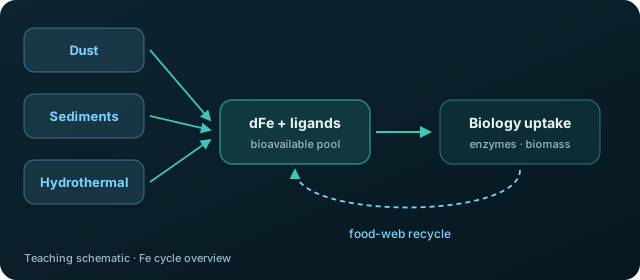
Source: Tagliabue et al. (2017) Tagliabue et al. (2017): iron regulates productivity magnitude and dynamics. Sources are diverse — dust, sediments, hydrothermal, and recycling — not dust alone.
Source: Conway & John (2014) GEOTRACES-era open-ocean dissolved Fe (dFe) is typically on the order of ~0.1–1 nM; remote HNLC surfaces can sit well below 0.1 nM (Conway / GEOTRACES Intermediate Data Product syntheses).
Organic ligands usually exceed dFe and keep iron dissolved. Source: Rue & Bruland (1995) In open-ocean surface waters, dissolved Fe(III) is overwhelmingly complexed by natural organic ligands (Rue & Bruland 1995). Teaching preference: ligand∶dFe framing over mineral “more Fe” narratives.
Explorer default total Fe-binding ligands [Lt] ≈ 1.5 nM Fe-equivalents is an Assumption (typical excess-ligand order; regional medians vary).
Bioavailable iron for enzyme pathways
Photosystems, nitrate reductase, and nitrogenase all need iron atoms inside the cell. Chemistry decides how much dissolved Fe stays soluble and photo-labile enough to reach those enzymes. Biology decides which pathways run. Explorer still reports tonnes C and N; Fe stays a driver.
-
Ligands keep Fe dissolved
In open-ocean surface waters, dissolved Fe(III) is overwhelmingly complexed by natural organic ligands. Ligands usually exceed dFe and keep iron dissolved so cells can access it for Fe-dependent enzymes. Source: Rue & Bruland (1995) (Rue & Bruland 1995).
-
Light frees Fe from ligands
Photochemical cycling of Fe(III)–ligand complexes (ligand-to-metal charge transfer) can reduce Fe(III) to more available Fe(II) in sunlit surface water — a bioavailability step upstream of photosynthetic and N-assimilation enzymes. Ambient photochemistry, not designed catalysis. Source: Barbeau et al. (2001) (Barbeau et al. 2001).
-
Nitrate raises Fe demand
Growing on nitrate rather than ammonium raises cellular iron demand because nitrate and nitrite reductase are Fe-dependent. Speciation and ligand supply set whether that extra demand can be met — the chemistry twin of the biology nitrate-reduction card. Source: Maldonado & Price (1996) (Maldonado & Price 1996).
-
Febio teaching gate
Flux Explorer’s bioavailable-Fe proxy Febio ≈ min(dFe, [Lt]) is a saturated-ligand ceiling for sensitivity only — Assumption. It does not unlock nitrogenase success, Fe tonnes,. Enzyme identity lives on Biology.
Biology names the Fe enzymes (photosystems, nitrate reductase, nitrogenase). Chemistry sets the ligand / light / dFe gate. See also Twining & Baines 2013 for cellular Fe quotas Source: Twining & Baines (2013).
Phosphorus, silicon, and other micros
P and Si co-shape guilds; Zn, Cu, Mn, Co, Mo are enzyme cofactors that can co-limit with Fe or N.
-
Phosphate / DOP
Co-limiter when N∶P supply and demand diverge. Surface ranges in explorers are Assumption teaching boxes, not station means.
-
Silicic acid
Builds diatom frustules; Si∶N shifts favour or suppress export-prone guilds. HNLC-capable defaults are teaching Assumption.
-
Other micros
Moore et al. (2013) note vitamins and micronutrients may co-limit; spatial patterns remain unclear. Explorer v1 keeps these narrative unless a Zn slider is opened.
-
H and O (light touch)
Water is solvent and reactant; O₂ is metabolic product/reactant and a hypoxia indicator — stop hooks live on the biology page. Air–sea exchange is owned mainly by physics.
Redfield is important — cycling is larger
Classic Redfield C∶N∶P ≈ 106∶16∶1 (mol∶mol) — Source: Redfield (1958) as the conventional reference for bulk phytoplankton biomass stoichiometry (Redfield 1958 / reviews). Source: Martiny et al. (2013) Particulate C∶N∶P ratios in the upper ocean show strong latitudinal patterns and can depart substantially from canonical Redfield (Martiny et al. 2013). Redfield remains the right teaching anchor for how much C can sit next to available N and P (see Cpot in Flux Explorer — potential only, not export).
Diet and excretion cycling is much greater than that static ratio alone. Consumers eat, metabolise, and excrete continuously. Those recycling loops keep nutrients in the sunlit ocean and help keep the biological pump running — often moving more mass on short timescales than a one-time Redfield “inventory” snapshot suggests. Assumption (order: cycling ≫ standing-stock stoichiometry for teaching; founder report, Ocean Flux emphasis).
Most of a consumer’s diet is not Redfield stoichiometry. Prey mix (phytoplankton guilds, detritus, microbes, other animals) rarely matches 106∶16∶1. Excreted N, P, Fe, and ligand-active organics therefore diverge from Redfield too. Assumption (founder report until guild-cited).
Real phytoplankton communities also deviate from Redfield. Treat guild-specific deviations as Assumption unless cited. Moore et al. (2013) remain the teaching map for where N versus Fe tends to limit.
Derived teaching proxy (linked to ligand ceiling): Febio ≈ min(dFe, [Lt]) — saturated-ligand ceiling (Assumption).
Algae excretions — quantify the Unknown
Phytoplankton release dissolved organic matter (exudates / excretions): ligands, DOC, DON, and other metabolites that reshape bioavailability and the microbial loop.
Unknown Global or regional mass-balance for algae excretion fluxes (DOC/DON/ligand production rates as a fraction of primary production) is not locked on this site. Published estimates span wide ranges by taxa, light, nutrient stress, and method. Phase A teaching rule: show the pathway, label magnitudes Unknown,.
Working placeholder for explorers (sensitivity only): excretion as ~2–40% of fixed carbon leaking to DOC depending on guild and stress — Assumption envelope. Prefer site- and taxa-specific cites before any public number is upgraded.
Isotopes — tracing ocean fluxes
Stable and radioisotopes do not dose the ocean. They fingerprint where mass came from and which process moved it. For Ocean Flux they are a teaching and future-monitoring toolkit: source attribution for iron, carbon-pathway context, and nitrogen-cycle process tags — not Flux Explorer sliders.
-
Iron isotopes (δ⁵⁶Fe)
Different dissolved-Fe sources carry different iron-isotope fingerprints (dust, margin sediments, hydrothermal). Along a North Atlantic section, Fe isotopes helped quantify those source shares Source: Conway & John (2014) (Conway & John 2014). Ocean Flux use: tell anthropogenic / regenerative Fe stories apart from dust or ridge inputs when monitoring is designed — Assumption for site programs.
-
Carbon isotopes (δ¹³C)
The 13C/12C of dissolved inorganic carbon records air–sea exchange and anthropogenic CO₂ invasion Source: Quay et al. (2003) (Quay et al. 2003). Radiocarbon (Δ14C) is a complementary ventilation clock — Assumption for site magnitudes until a named cruise cite. Inventory maps of the oceanic anthropogenic CO₂ sink (Sabine et al. 2004; https://doi.org/10.1126/science.1097403) are context. Ocean Flux use: keep air–sea vs organic-pump pathways separate — never collapse isotopes into a “sequestered tonnes” number.
-
Nitrogen isotopes (δ¹⁵N)
The δ15N of nitrate (and organic N) records nitrate consumption, regeneration, and circulation fingerprints in the interior Source: Sigman et al. (2000) (Sigman et al. 2000). Ocean Flux use: process tag for N uptake vs regeneration pathways that sit beside explorer N-tonne headlines — Assumption until a named cruise or program cites local baselines.
Flux Explorer — chemistry inputs
Six teaching sliders. Defaults are labeled; recommended ranges are sensitivity tools for exploring assumptions.
| Symbol | Label | Unit | Default | Status |
|---|---|---|---|---|
| [NO₃⁻] | Nitrate (surface box) | µmol L⁻¹ | 8 | Assumption HNLC-ish ETP teaching box (Moore 2013 regime map) — teaching default |
| [PO₄³⁻] | Phosphate | µmol L⁻¹ | 0.7 | Assumption Redfield-consistent with default N (~16∶1) |
| [Si(OH)₄] | Silicic acid | µmol L⁻¹ | 15 | Assumption diatom-capable HNLC order |
| dFe | Dissolved Fe | nmol L⁻¹ | 0.15 | Source: Conway & John (2014) (order of magnitude) GEOTRACES open-ocean ~0.1–1 nM; default near HNLC-low |
| [Lt] | Total Fe-binding ligands | nM Fe-eq. | 1.5 | Assumption typical excess-ligand order |
| DIC | Dissolved inorganic C | µmol kg⁻¹ | 2100 | Assumption modern surface-ocean order |
Try them in the Flux Explorer. Biology and physics pages supply the food-web and supply-pathway context.
Key citations
- Moore, C. M., et al. (2013). Processes and patterns of oceanic nutrient limitation. Nature Geoscience, 6, 701–710. https://doi.org/10.1038/ngeo1765
- Tagliabue, A., et al. (2017). The integral role of iron in ocean biogeochemistry. Nature, 543, 51–59. https://doi.org/10.1038/nature21058
- GEOTRACES Intermediate Data Product syntheses — dissolved Fe order of magnitude (e.g. Conway and related Oceanography overviews).
- Redfield stoichiometry — conventional C∶N∶P reference (Redfield 1958 / reviews).
- Conway, T. M., & John, S. G. (2014). Quantification of dissolved iron sources to the North Atlantic Ocean. Nature, 511, 212–215. https://doi.org/10.1038/nature13482
- Quay, P., Sonnerup, R., Westby, T., et al. (2003). Changes in the 13C/12C of dissolved inorganic carbon in the ocean as a tracer of anthropogenic CO2 uptake. Global Biogeochemical Cycles, 17(1), 1004. https://doi.org/10.1029/2001GB001817
- Sabine, C. L., et al. (2004). The oceanic sink for anthropogenic CO2. Science, 305, 367–371. https://doi.org/10.1126/science.1097403
- Sigman, D. M., Altabet, M. A., McCorkle, D. C., Francois, R., & Fischer, G. (2000). The δ15N of nitrate in the Southern Ocean: Nitrogen cycling and circulation in the ocean interior. Journal of Geophysical Research: Oceans, 105(C8), 19599–19614. https://doi.org/10.1029/2000jc000265
- Barbeau, K., Rue, E. L., Bruland, K. W., & Butler, A. (2001). Photochemical cycling of iron in the surface ocean mediated by microbial iron(III)-binding ligands. Nature, 413, 409–413. https://doi.org/10.1038/35096545
- Maldonado, M. T., & Price, N. M. (1996). Influence of N substrate on Fe requirements of marine centric diatoms. Marine Ecology Progress Series, 141, 161–172. https://doi.org/10.3354/meps141161
- Twining, B. S., & Baines, S. B. (2013). The trace metal composition of marine phytoplankton. Annual Review of Marine Science, 5, 191–215. https://doi.org/10.1146/annurev-marine-121211-172322
- Wanninkhof, R., et al. (2013). Global ocean carbon uptake: magnitude, variability and trends. Biogeosciences, 10, 1983–2000. https://doi.org/10.5194/bg-10-1983-2013
- Zeebe, R. E. (2012). History of seawater carbonate chemistry, atmospheric CO2, and ocean acidification. Annual Review of Earth and Planetary Sciences, 40, 141–165. https://doi.org/10.1146/annurev-earth-042711-105521
- Hain, M. P., Sigman, D. M., & Haug, G. H. (2014). The biological pump in the past. In H. D. Holland & K. K. Turekian (Eds.), Treatise on geochemistry (2nd ed., Vol. 8, pp. 485–517). Elsevier. https://doi.org/10.1016/B978-0-08-095975-7.00618-5
- Boyd, P. W., Claustre, H., Levy, M., Siegel, D. A., & Weber, T. (2019). Multi-faceted particle pumps drive carbon sequestration in the ocean. Nature, 568, 327–335. https://doi.org/10.1038/s41586-019-1098-2
- Martiny, A. C., et al. (2013). Strong latitudinal patterns in the elemental ratios of marine plankton and organic matter. Nature Geoscience, 6, 279–283. https://doi.org/10.1038/ngeo1757
- Rue, E. L., & Bruland, K. W. (1995). Complexation of iron(III) by natural organic ligands in the Central North Pacific as determined by a new competitive ligand equilibration/adsorptive cathodic stripping voltammetric method. Marine Chemistry, 50, 117–138. https://doi.org/10.1016/0304-4203(95)00031-L
Disclaimer strip
Teaching model only. See Disclaimer and Support.